
August 17, 2026
Your Members Aren't Just Records
Why understanding relationships matters in association management software
An association is more than a membership list. It is a network of people, organizations, roles, and relationships. People are complicated. Their professional communities are, too.
Yet many association management systems flatten that complexity into contact records and disconnected fields. They may store a person's ZIP code, chapter, employer, and membership status without understanding how those pieces relate to one another.
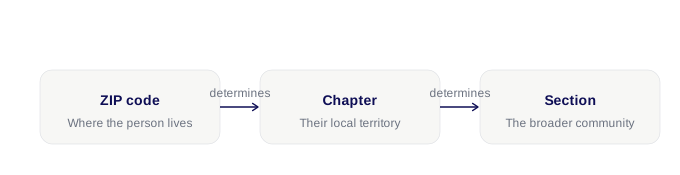
If a new ZIP code changes a member's chapter, and that chapter determines their larger section community, the system should understand the chain of logic and what else may need to change. Too often, it does not.
That is the difference between storing information and understanding relationships.
Associations are networks. Most software stores records.
A conventional database is very good at storing facts: a name, an address, an employer, a membership type. Association work depends on something more demanding. The system must understand how those facts connect and what those connections mean.
Consider the ZIP-code example. The person lives in a defined territory. That territory places them in a chapter. The chapter belongs to a broader section.
This is one of Opalite Cloud's guiding principles: association management software should understand relationships, not just store fields.
Each connection may affect communications, leadership opportunities, dues allocation, event eligibility, reporting, or the communities they see when they log in. The logic is interdependent. It cannot be represented accurately by one field labeled "chapter" and another labeled "section."
Now add an employer relationship, a committee appointment, a certification, a corporate billing contact, or a household membership. The person has not become five people. They are one person participating in several overlapping networks, each with its own meaning, history, and rules.
Membership is a relationship, not a definition of the person
This distinction matters because not everyone in an AMS is a current member. An association may have prospects, event attendees, former members, donors, speakers, volunteers, customers, corporate contacts, and people whose membership has lapsed and may be worth reengaging.
If the person record is treated as synonymous with "member," the system loses useful context as soon as that status changes. A lapsed member should not disappear or become a lesser version of a record. The person still has a history: when they joined, where they worked, which events they attended, which committees they served on, what they purchased, and when their engagement began to decline.
That continuity is what makes meaningful reengagement and analytics possible. An association should be able to distinguish a brand-new prospect from a ten-year member who lapsed six months ago. Those people may share the same current status, but they should not receive the same experience.
The relationship itself needs structure
A flexible relationship model does more than place links between records. It gives those links meaning. A person can be an employee of an organization, the billing contact for that organization, and the guardian of another person. One organization can be the parent of a subsidiary or affiliate. The labels are directional: employer and employee describe the same connection from different sides.
The system may also need to know whether a relationship is primary, when it began and ended, whether several relationships of that type are allowed, and whether the association defines it as one-to-one, one-to-many, or many-to-many. Those are not technical niceties. They determine whether the software can reflect how the community actually operates.
Just as important, relationships must remain separate from contact information, user accounts, and permissions. An email address explains how to reach someone. A user account explains how they sign in. A relationship explains how they are connected. A permission explains what they are allowed to see or do. Combining those concepts may seem simpler at first, but it creates duplication, security risks, and brittle workarounds later.
Rigid systems push the real logic outside the AMS
When an AMS cannot represent the model, association staff become the integration layer. They memorize exceptions, maintain mapping tables, copy contact details across records, and manually correct downstream assignments. Institutional knowledge lives in the person who knows that one ZIP code is an exception, one company contact should receive the consolidated bill, or one chapter rolls into a different section than the system assumes.
That hidden labor is expensive, but the larger cost is that the AMS stops being a reliable source of truth. Staff hesitate to automate because they do not trust the underlying assignments. Reports answer only the question the rigid fields were designed to answer. A change to the association's structure becomes a technology project because the software encoded yesterday's model as if it would never change.
Associations should be able to define the relationships and rules that reflect their community, then evolve them without rebuilding the entire system. Flexibility is not an extra feature. It is protection against being trapped by decisions made years earlier.
This is also the foundation for useful AI
An AI-native AMS cannot be genuinely intelligent if it does not understand the underlying relationship model. Natural-language search is only impressive if the answer respects real relationships, history, and permissions.
Imagine a future where you could ask, "Which lapsed members in the Western chapter previously served on a committee but have not attended an event this year?" Or, "Which corporate billing contacts manage members across more than one subsidiary?" That kind of answer does not come from the AI alone. It depends on an engine that knows what a person is, what membership means, how organizations and communities relate, which relationships are current, and what the user is permitted to access.
Without that foundation, AI can search faster and summarize faster, but it cannot reason reliably about the association. It simply produces faster answers from incomplete context. Building the relationship engine first is what makes future AI experiences relevant, explainable, and safe.
We are building the model associations actually need
At Opalite Cloud, we are designing the relationship model beneath every association early, because it is not a feature that can be bolted on later. Membership, chapters, sections, organizations, households, billing, access, reporting, and AI all depend on it.
We are building for flexibility because we know what it feels like to work inside an AMS that was not. Association staff should not have to flatten their communities, abandon valuable history, or build manual processes around the limits of their software.
Your AMS should understand more than who is a member today. It should understand the people in your community, the relationships that connect them, the rules that shape those relationships, and how all of it changes over time.
Associations are not lists of records. They are living networks. Their technology should be built accordingly.
See how it works. Request a demo →
More from the blog
September 7, 2026
Why Your AMS Does Not Need to Do Everything
The case for a best-of-need approach to association technology, and what an AMS should own versus where specialized platforms may serve associations better.
August 31, 2026
How Long Does AMS Implementation Take? Why It Doesn't Have to Be a Year
AMS implementation timelines vary, but a modern, well-scoped rollout can often launch in weeks rather than the six to twelve months associated with legacy systems. Here's what actually determines the timeline.
August 24, 2026
How to Prepare for an AMS Demo That Actually Helps You Decide
A useful AMS demo starts with your requirements, not the vendor's feature list. Here's how to build an RFP, write real demo scenarios, and evaluate vendors fairly.